


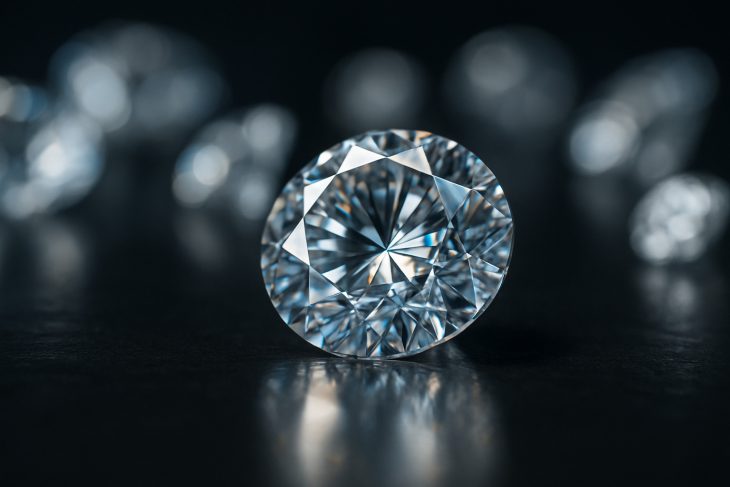
Are diamonds just pretty stones? Not quite. These crystals hold a legacy shaped by nature, science, and human history. Formed deep beneath the Earth or delivered from space, diamonds have long been symbols of power, luxury, and endurance. But their story doesn’t stop at beauty—there’s physics, industry, and culture behind every facet. This article breaks down 30 surprising facts about diamonds, grouped by category to reveal what truly makes them extraordinary.
Formation & Origins
1. Diamonds are over 3 billion years old
Most natural diamonds formed between 1 to 3.5 billion years ago, deep within Earth’s mantle under high pressure and temperature.
2. Made of a single element: carbon
Diamonds are pure carbon atoms arranged in a tetrahedral lattice, making them the hardest known natural substance.
3. Formed 100 miles beneath Earth’s surface
They originate from depths around 150 kilometers and are brought to the surface through volcanic eruptions via kimberlite pipes.
4. Some diamonds arrive from space
Meteorites have been found with nanodiamonds, suggesting their existence in the universe long before Earth formed.
5. Volcanic eruptions deliver them
Diamonds reach the surface through rare deep-origin volcanic events, riding up in magma called kimberlite or lamproite.
Physical Properties
6. Hardest known natural material
Scoring a perfect 10 on the Mohs hardness scale, diamonds can only be scratched by other diamonds.
7. Exceptional thermal conductivity
Diamonds transfer heat five times better than copper, making them valuable in electronics and industrial applications.
8. Not unbreakable
Despite their hardness, diamonds can fracture if struck in the right direction due to their cleavage planes.
9. Fluorescence under UV light
About 30% of diamonds glow blue under ultraviolet light, a trait used to verify authenticity.
10. Burn at extremely high temperatures
Diamonds can combust at temperatures above 850°C (1,562°F) in the presence of oxygen, turning into carbon dioxide.
Types & Colors
11. Come in every color
Natural fancy diamonds include blue, pink, yellow, green, red, and black, caused by structural anomalies or trace elements.
12. Blue diamonds contain boron
The presence of boron atoms gives blue diamonds like the Hope Diamond their signature hue.
13. Yellow diamonds have nitrogen
Nitrogen impurities absorb blue light, giving these diamonds their golden appearance.
14. Red diamonds are the rarest
They result from deformation in the crystal lattice and are so rare that only a few dozen exist globally.
15. Black diamonds contain graphite
Also known as carbonado, they have a polycrystalline structure with inclusions that make them opaque.
Famous Diamonds
16. The Hope Diamond is cursed—allegedly
This 45.52-carat blue diamond has a reputation tied to misfortune, though it’s now safely displayed at the Smithsonian.
17. Cullinan Diamond is the largest ever found
Discovered in South Africa in 1905, the Cullinan weighed 3,106 carats uncut. Its pieces are in the British Crown Jewels.
18. Koh-i-Noor has a contested past
This 105.6-carat diamond was seized during British colonial rule and is a subject of international ownership disputes.
19. Pink Star sold for $71.2 million
This flawless 59.60-carat pink diamond set a world record at Sotheby’s in 2017.
20. Regent Diamond adorned Napoleon
Once part of Napoleon Bonaparte’s sword hilt, it now resides in the Louvre.
Market & Trade
21. De Beers once controlled 90% of the market
This company built a century-long monopoly through marketing and supply control.
22. “A Diamond is Forever” is a marketing invention
Coined by De Beers in 1947, this slogan transformed diamond engagement rings into a global custom.
23. Synthetic diamonds are chemically identical
Lab-grown diamonds have the same physical and optical properties as mined ones, often at a lower cost.
24. Kimberley Process aims to stop conflict diamonds
Established in 2003, it attempts to prevent diamonds from funding war, though its effectiveness is debated.
25. Russia is the top producer by volume
Alrosa, a state-owned company, mines more carats annually than any other producer.
Cultural & Scientific Impact
26. Ancient Hindus believed diamonds were protective
In India, diamonds were once thought to ward off evil and bring clarity of mind.
27. Romans thought diamonds were splinters of stars
They believed diamonds came from falling stars and possessed mystical energy.
28. Used in high-tech tools and surgery
Diamond-tipped blades and drills are used in cutting, grinding, and even scalpels for eye surgery.
29. Exist inside gas giants like Jupiter
Extreme pressure in these planets may cause carbon to crystallize into diamond rain.
30. Used in quantum computing research
Diamond defects, known as nitrogen-vacancy centers, are helping scientists develop new quantum sensors and memory systems.
More Than Just Sparkle
Diamonds are far more than glittering ornaments—they’re geological wonders, scientific tools, and cultural icons. Formed under unimaginable pressure, their journey from deep Earth or outer space to human hands spans billions of years. From ancient myths to modern technology, diamonds continue to play roles in art, history, and innovation. Their rarity, structure, and symbolism have kept them at the center of fascination across civilizations. Whether mined or lab-grown, their value lies not only in brilliance but also in the layers of story, science, and significance they carry.
Was this page helpful?
Our commitment to delivering trustworthy and engaging content is at the heart of what we do. Each fact on our site is contributed by real users like you, bringing a wealth of diverse insights and information. To ensure the highest standards of accuracy and reliability, our dedicated editors meticulously review each submission. This process guarantees that the facts we share are not only fascinating but also credible. Trust in our commitment to quality and authenticity as you explore and learn with us.